



Short answer: a floor-loaded container carries cartons or bags stacked directly on the container floor, without pallets. It usually carries more product, so freight per unit falls, but it takes longer to unload and puts every carton through more hand handling. A palletised load gives up floor space, height and some payload to pallets, but moves by forklift. Which gives the lower price per unit you can sell depends on whether the container fills by volume or weight first, what the receiving warehouse can handle and what the destination channel buys. Test the format on paper before ordering.
A format that fills a container's space long before its weight limit is a pricing decision disguised as a packaging decision.
Four costs that move when the pack changes
Moving the same product from a 200 g retail pack to a 10 kg carton or a 50 kg bag moves four costs:
- Packaging cost per kilo. Small packs carry more film, board and labour per kilo, whether or not the quotation shows it.
- Freight per unit. Freight is charged per container, so the more product the pack puts in the box, the less freight each unit carries.
- Handling and damage. Pallets, floor loading and carton strength change the handling bill and how many units arrive saleable.
- Duty and customs value. Packing is part of what customs values. Under the WTO Customs Valuation Agreement, the cost of containers treated as one with the goods and the cost of packing, "whether for labour or materials", are added to the price actually paid or payable WCO Trade Tools, WTO Valuation Agreement article 8.1(a). In the EU, Union Customs Code article 71 adds them to the extent the buyer bears them and they are not already in the price as Irish Revenue's valuation manual explains Irish Revenue, Customs Manual on Valuation, section 3.7(d). Pack size can also change the tariff line itself. In the Harmonized System, green and black tea are classified differently when in immediate packings of 3 kg or less WCO, HS 2022 chapter 9, heading 09.02. National tariffs decide whether the rate differs.
Weighing out versus cubing out
Every container has two limits: internal volume and maximum payload. A load "cubes out" when it fills the space before reaching the weight limit, and "weighs out" when it hits the weight limit with space to spare.
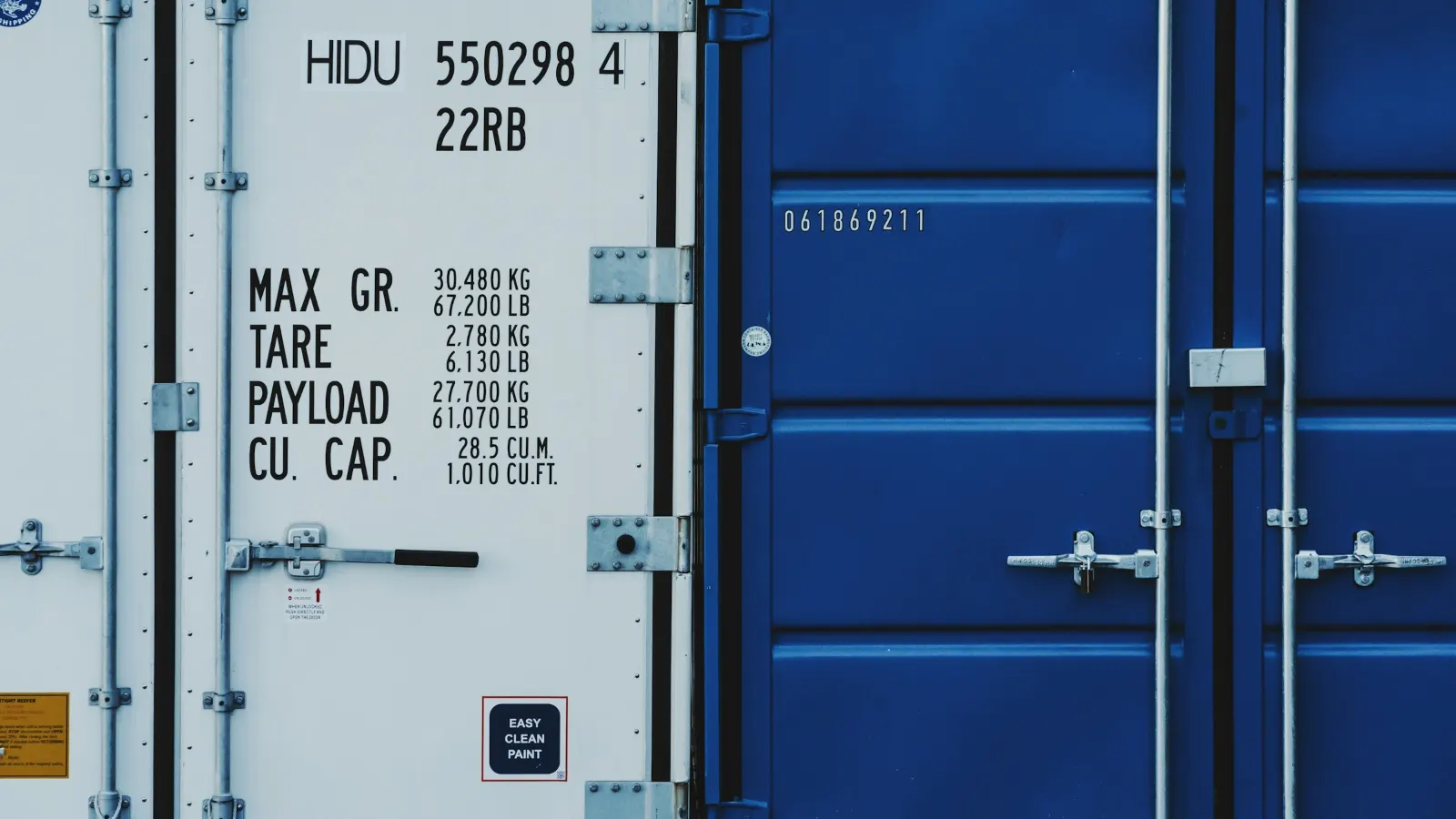
In one carrier's published specifications, a 40-foot standard container has 67.7 m³ of capacity and a maximum payload of 28,750 kg; a 20-foot has 33.2 m³ and 28,130 kg. The 40-foot has twice the volume but barely more payload. Its internal dimensions are 12,032 × 2,352 × 2,395 mm, with a door opening of 2,340 × 2,292 mm Hapag-Lloyd, 40' standard container; Hapag-Lloyd, 20' standard container. These are example figures from one fleet; containers vary by manufacturer, and ratings and external dimensions are standardised in ISO, ISO 668 series 1 freight containers.
The consequence for pack choice:
- Light, bulky products cube out. Biscuits and snacks in retail packs fill a container well below its weight limit, so air in a carton and every pallet are paid for in freight.
- Dense products weigh out. Sugar, rice, flour and milk powder in sacks can reach the weight limit before the box is full. Pallets then cost payload as well as space.
- Road limits may bind first. Inland road weight rules differ by country and may cap the load below the payload; ask your forwarder for the working maximum on the route.
The choice between a full container, a shared one or breakbulk comes before this question; see FCL, LCL or breakbulk for food cargo.
Primary, secondary and tertiary packaging
Packaging works in three layers, and each has its own cost and failure mode:
| Layer | Example | What it pays for | What goes wrong |
|---|---|---|---|
| Primary | 200 g flow-wrap, 1 kg pouch, 50 kg woven sack | Product protection, shelf life, the label the consumer reads | Punctures, seal failures, moisture pick-up |
| Secondary | Shipper carton of 24 packs | Counting, stacking, the unit the wholesaler buys | Crushing in tall stacks, weak board in humid routes |
| Tertiary | Pallet, stretch film, corner boards, slip sheet | Mechanical handling, load stability | Pallet treatment and marking, overhang, collapsed wrap |
Before paying for more protection, sort your own claims and receiving records by point: stuffing, discharge, devanning, warehouse and delivery. If most losses come from hand unloading, a pallet may pay for itself; if they come from crushed bottom tiers, stronger cartons or lower stacks may matter more.
Retail, food-service and bulk: what each channel can handle
| Format | Typical buyer | Container effect | What it asks of the destination |
|---|---|---|---|
| Retail packs in shipper cartons | Supermarkets, wholesalers, traditional trade | Highest packaging cost per kilo; lightweight formats cube out | Shelf-ready labels in the required language; carton sizes shops will accept |
| Food-service packs | Bakeries, caterers, restaurants, institutions | Denser loads; fewer packs to handle | A customer base that buys by the case or sack |
| Bulk sacks or bags | Repackers, processors, industrial users | Densest load; often weighs out | A repacking or processing step, with its own approvals and cost |
Buying bulk and repacking at destination moves the packaging cost rather than removing it, and adds a production step the destination may license or inspect.
Marking, language and labelling as a per-market variable
Every destination language, legal text and barcode adds a label version, and each printed version can carry its own print minimum. Labelling cost rises with the number of markets, not with volume.
Two cheaper routes have limits. Under the Codex general labelling standard, where the original label's language is not acceptable to the intended consumer, a supplementary label carrying the mandatory information in the required language may be used instead of relabelling Codex Alimentarius, General Standard for the Labelling of Prepackaged Foods, CXS 1-1985, section 8.2. A single bilingual design can serve two markets. National labelling law decides whether either is acceptable in your market, and Codex is a reference, not that law. The private-label page lists the pack, artwork and document decisions to settle before a branded enquiry.
Carton counts and weights per format also feed the packing list and weight note; see packing list, weight note and the arithmetic customs will check.
Palletised versus floor-loaded, and the handling reality at destination
Pallets use space and payload. Under SOLAS, the shipper must provide a verified gross mass for each packed container. One of the two permitted methods adds the mass of all packages and cargo items, "including the mass of pallets, dunnage and other securing material", to the container's tare IMO, verification of the gross mass of a packed container. Pallet weight counts against the load, and the pallet's own height comes off the stack.
Wooden pallets bring a plant-health requirement. ISPM 15 covers wood packaging including pallets, crates and dunnage. Raw-wood pallets must be treated by an approved method and carry the ISPM 15 mark. Packaging made wholly of processed wood, such as plywood, particle board or oriented strand board, is exempt. Where the required mark is missing, the importing country's plant protection organisation may detain, treat, destroy or reship the material IPPC, ISPM 15 regulation of wood packaging material; IPPC, ISPM 15 text, 2018 revision. Principal pallet dimensions are standardised in ISO, ISO 6780 flat pallets; confirm the footprint your destination warehouses and racking accept.
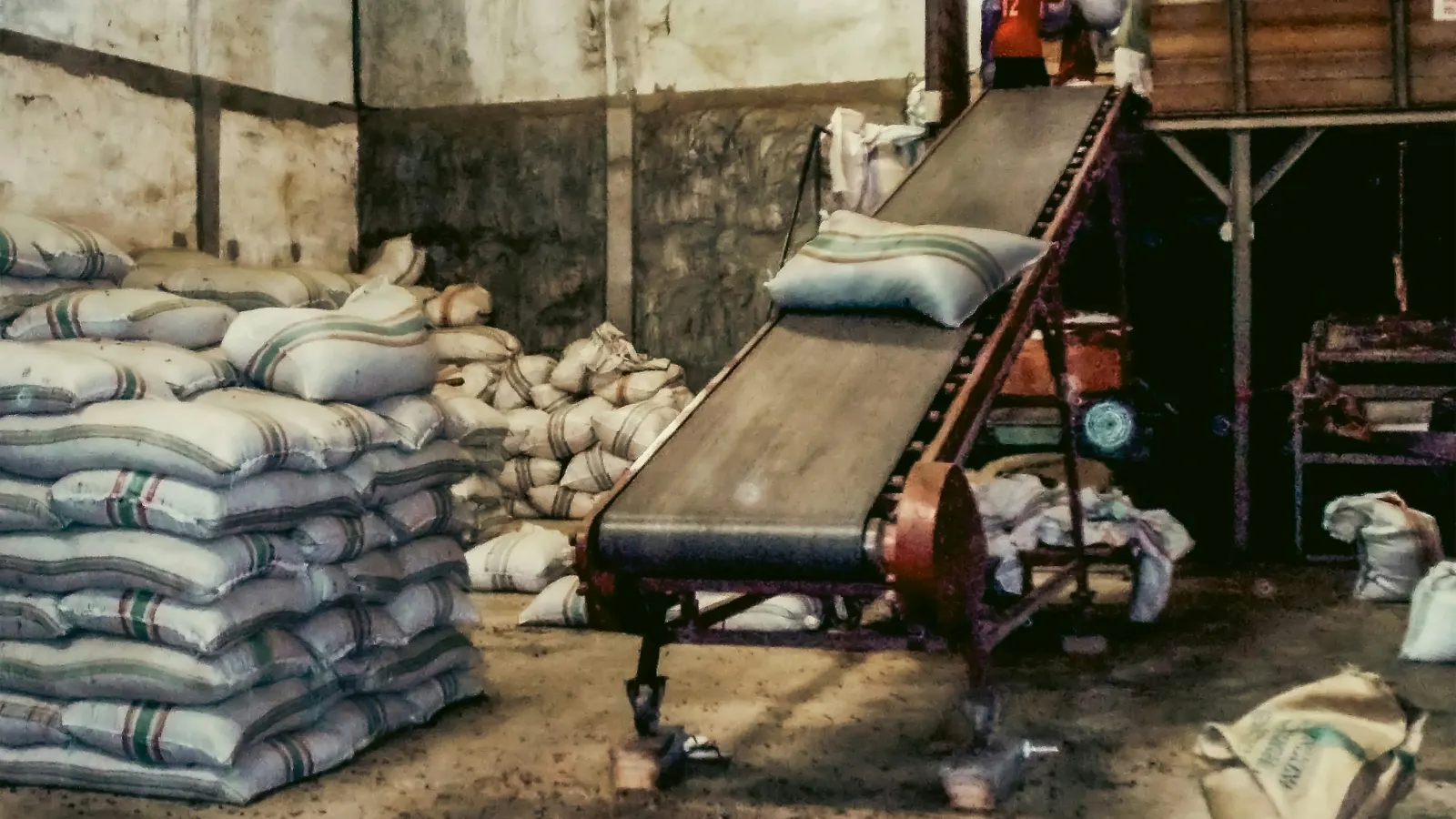
Floor loading moves the cost to people and time. Every carton or bag is handled by hand at both ends, and unloading time counts against container free time; see demurrage and detention explained for how those charges build. Ask the receiving warehouse whether it accepts floor-loaded containers and what it charges to unload them.
How to stow, block and secure either kind of load is covered in container stuffing and cargo securing for bagged and cartoned food.
Testing a format on paper before ordering
Run this test for each format before asking for a firm quotation:
- Get the carton and pallet data: outer carton dimensions and gross weight, units per carton, cartons per pallet layer and layers per pallet.
- Compute the fill both ways: cartons that fit by internal dimensions and door height, and the weight that load would reach. Whichever limit binds first sets the load.
- Apply the route's working weight, not the container's nominal payload, if road rules or the forwarder set a lower cap.
- Add the tertiary cost: pallets (treated and marked), film and corner boards, or the extra loading and unloading labour of a floor load.
- Divide by saleable units, after the loss allowance your own records support.
- Check the channel: can the destination buyer take this pack and this carton, and can the warehouse unload this way?
- Ask for the supplier's load plan and compare it with yours.
Worked example: one biscuit programme, three formats
Hypothetical teaching example. The products, prices, freight and handling charges are invented in CU (currency units) to show the arithmetic. They are not market rates or a commercial offer.
An importer compares three biscuit formats in one 40-foot standard container (internal dimensions above), at 3,000 CU freight. Assumptions: retail cartons of 24 × 200 g packs (4.8 kg net, 5.4 kg gross, 400 × 300 × 250 mm); food-service cartons of 10 kg net (10.6 kg gross, 500 × 400 × 250 mm); pallets of 1,200 × 1,000 mm, 25 kg each, costing 16 CU with film and corner boards; simple stacking patterns only.
| A. Retail, palletised | B. Retail, floor-loaded | C. Food-service, floor-loaded | |
|---|---|---|---|
| Load pattern | 20 pallets, 9 cartons × 8 layers each | 7 across × 30 deep × 9 high | 5 across × 24 deep × 9 high |
| Cartons | 1,440 | 1,890 | 1,080 |
| Net product | 6,912 kg | 9,072 kg | 10,800 kg |
| Share of payload used (gross incl. pallets) | 28.8% | 35.5% | 39.8% |
| Limit that binds | Floor space and door height | Volume | Volume |
| Freight per kg | 0.434 CU | 0.331 CU | 0.278 CU |
| Freight per 200 g pack | 0.087 CU | 0.066 CU | n/a |
| Pallets and wrap | 320 CU | none | none |
| Destination unloading (invented) | 120 CU | 350 CU | 300 CU |
| Loss allowance (invented) | 0.5% | 1.0% | 1.0% |
| Product price (invented) | 2.60 CU/kg | 2.60 CU/kg | 2.20 CU/kg |
| Total to warehouse door | 21,411.20 CU | 26,937.20 CU | 27,060.00 CU |
| Cost per saleable kg | 3.113 CU | 2.999 CU | 2.531 CU |
All three cube out: none uses 40% of the payload. Pallets cut the retail load by 450 cartons: they take floor area and 150 mm of height, and each loaded pallet (2,150 mm) must pass the 2,292 mm door. Floor loading lowers the cost per saleable 200 g pack from 0.623 CU to 0.600 CU despite higher unloading and loss allowances. The food-service format is cheapest per kilo, but only if the importer has bakery or catering buyers for 10 kg cartons.
A dense product reverses the picture. The same importer prices white sugar in a 20-foot container at 2,000 CU freight, with a forwarder's working cargo limit of 22,000 kg (invented for the route):
| 50 kg bags, floor-loaded | 1 kg packs in cartons, palletised | |
|---|---|---|
| Load | 440 bags, weight-limited (about 26.4 m³ at an assumed 0.06 m³ per bag) | 9 pallets (4 rows of 2, one turned), single tier: two 1,500 mm pallets would exceed the door height |
| Net product | 22,000 kg | 10,800 kg (1,200 kg per pallet) |
| Limit that binds | Weight | Floor space and height |
| Freight per kg | 0.091 CU | 0.185 CU |
| Pallets and unloading per kg (invented charges) | 0.014 CU | 0.023 CU |
Invented handling charges behind the fifth row: 308 CU to hand-unload the bags; 144 CU for pallets plus 104 CU forklift unloading for the palletised load.
The bags weigh out; the palletised retail pack cubes out at half the tonnage, doubling freight per kilo. But the retail pack goes straight to shelf, while bags need repacking at destination. The table shows the trade-off; it does not make the choice.
Common mistakes
- Comparing suppliers' unit prices without checking how many units each supplier's pack puts in a container.
- Using nominal container volume instead of a load plan that respects the door height and carton dimensions.
- Assuming pallets are free because the supplier provides them: their cost is in the price and in the lost space.
- Shipping untreated or unmarked wooden pallets to a market that enforces ISPM 15.
- Choosing floor loading without asking whether the receiving warehouse will unload it inside free time.
- Choosing a bulk format for a channel that only buys shelf-ready packs.
Limits and what to recheck
This is general educational information, not customs, freight or legal advice. Container figures are one carrier's examples. Road weight limits, labelling law, pallet requirements and valuation practice are national and change. Before ordering, confirm the working weight and load plan with your forwarder, packing valuation and tariff line with a licensed customs broker, and labelling and wood-packaging rules with the destination authority.
Frequently asked questions
What is a floor-loaded container? One in which cartons, bags or sacks are stacked directly on the floor, without pallets.
How many pallets fit in a 40-foot container? It depends on the pallet footprint and load plan. With 1,200 × 1,000 mm pallets and the dimensions above, a simple pattern fits 20 in one tier. A second tier depends on load height, door height and carton strength.
Is packaging included in customs value? Generally yes: packing labour and materials are added where the buyer bears them and they are not already in the price. Confirm national practice with a customs broker.
Is floor loading cheaper than palletising? For goods that cube out it usually lowers freight per unit; the cost per unit sold also depends on unloading labour, free time and damage.
Next step
Before comparing supplier prices, build one packing sheet for each option. Record units per carton, carton dimensions and gross weight, pallet footprint and loaded height, cartons and net weight per container, destination unloading method, and an evidence-based loss allowance. Divide the total freight, packing and handling cost by saleable units, then confirm the route's working weight with your forwarder and the valuation and labelling rules with a licensed customs broker.
Resources
- Hapag-Lloyd — 40' Standard container — https://www.hapag-lloyd.com/en/services-information/cargo-fleet/container/40-standard.html (accessed 29 September 2026)
- Hapag-Lloyd — 20' Standard container — https://www.hapag-lloyd.com/en/services-information/cargo-fleet/container/20-standard.html (accessed 29 September 2026)
- ISO — ISO 668:2020 Series 1 freight containers: classification, dimensions and ratings — https://www.iso.org/standard/76912.html (accessed 29 September 2026)
- ISO — ISO 6780:2003 Flat pallets for intercontinental materials handling: principal dimensions and tolerances — https://www.iso.org/standard/30524.html (accessed 29 September 2026)
- IPPC — ISPM 15, Regulation of wood packaging material in international trade — https://www.ippc.int/en/publications/regulation-wood-packaging-material-international-trade-0/ (accessed 29 September 2026)
- IMO — Verification of the gross mass of a packed container — https://www.imo.org/en/OurWork/Safety/Pages/Verification-of-the-gross-mass.aspx (accessed 29 September 2026)
- WCO Trade Tools — Valuation (WTO Agreement on Customs Valuation) — https://www.wcotradetools.org/en/valuation (accessed 29 September 2026)
- Irish Revenue Commissioners — Customs Manual on Valuation — https://www.revenue.ie/en/tax-professionals/tdm/customs/valuation/valuation.pdf (accessed 29 September 2026)
- World Customs Organization — HS Nomenclature 2022, chapter 9 — https://www.wcoomd.org/-/media/wco/public/global/pdf/topics/nomenclature/instruments-and-tools/hs-nomenclature-2022/2022/0209_2022e.pdf (accessed 29 September 2026)
- Codex Alimentarius (FAO/WHO) — General Standard for the Labelling of Prepackaged Foods, CXS 1-1985 — https://www.fao.org/fao-who-codexalimentarius/sh-proxy/fr/?lnk=1&url=https%3A%2F%2Fworkspace.fao.org%2Fsites%2Fcodex%2FStandards%2FCXS+1-1985%2FCXS_001e.pdf (accessed 29 September 2026; current edition amended 2026; section 8.2.1 unchanged)