



Volume, value, urgency and how sensitive the cargo is decide the mode for food. This guide covers when a part-filled container beats consolidation, why LCL is a food-safety question, when breakbulk becomes the practical choice and what each mode does to your documents.
Short answer: full container load (FCL) is priced per container; less than container load (LCL) per unit of weight or volume, plus handling at a container freight station (CFS) at each end; breakbulk loads bags or pallets piece by piece into a ship's hold. Below a certain volume LCL beats a container. For food, that arithmetic is half the decision: LCL cargo shares a box with goods you have not seen, and breakbulk cargo is handled bag by bag and exposed to the hold. Chilled or frozen cargo normally needs its own reefer.
The three modes in one paragraph each
FCL. You book the whole container and pay per box, plus terminal handling at each end and documentation. The price is the same whether the box is half full or full, within its weight limit. Your supplier's packer stuffs and seals it, and nobody else's goods go in.
LCL. Your cargo shares a container with other shippers' goods. The consolidator packs the container at a CFS, and the price depends mainly on the volume and weight your cargo takes up and the route (Maersk, LCL shipping (commercial source)). LCL tariffs commonly charge per "revenue ton", or W/M (weight or measurement): the greater of the cargo's volume in cubic metres or its weight in metric tonnes (Shipping and Freight Resource, CBM and freight ton, practitioner source). Light cargo is charged on volume; dense cargo on weight.
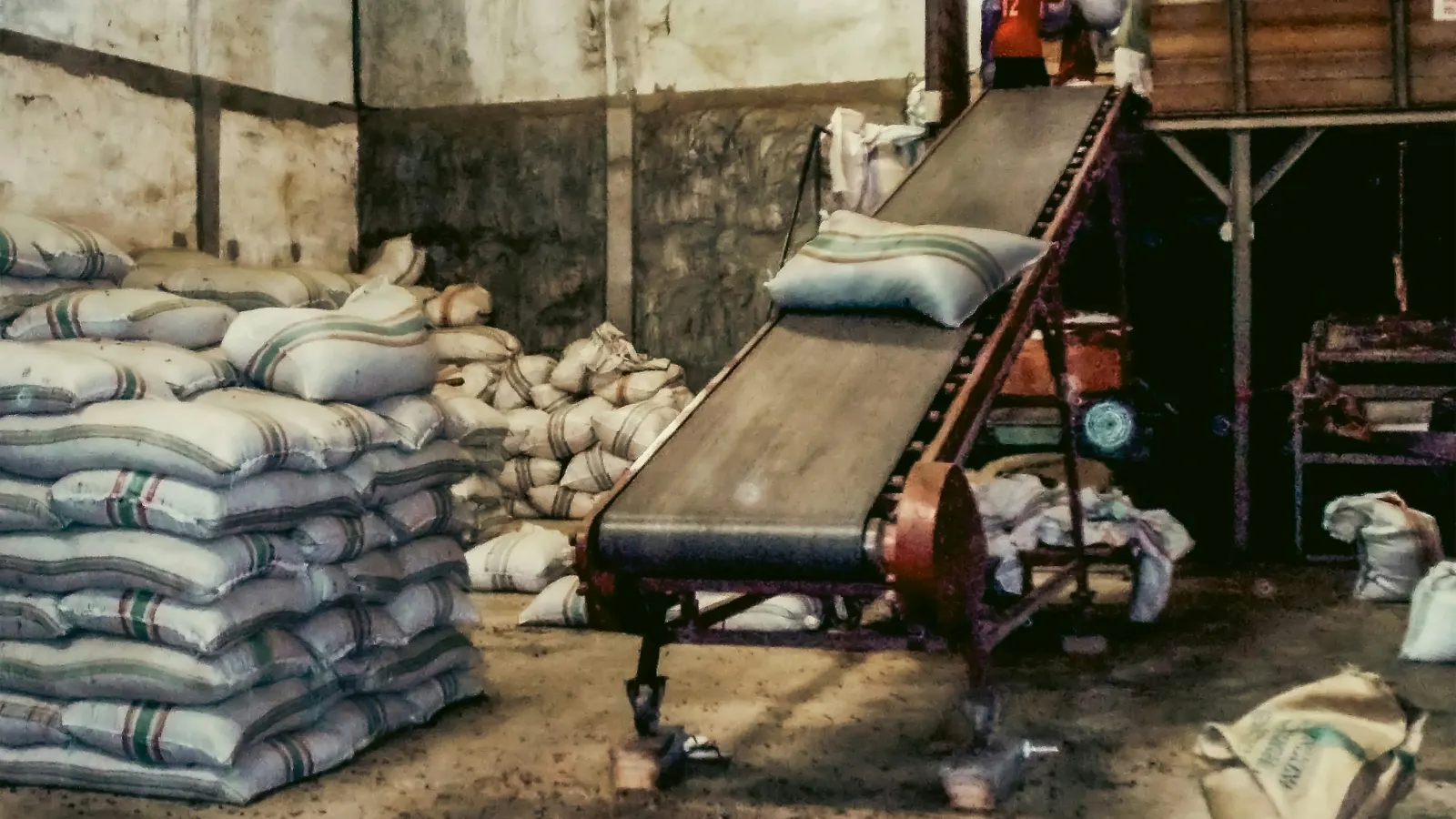
Breakbulk. UNCTAD material describes break-bulk as general cargo that requires individual loading and may be shipped in bags, crates, boxes, drums, barrels, bales or pallets. Bulk cargo, by contrast, is homogeneous cargo carried loose in the hold rather than enclosed in packages (UNCTAD, break-bulk description; UNCTAD, bulk-cargo definition). For food, breakbulk usually means bagged staples stowed directly in a ship's hold.
The break-even between LCL and a part-filled container
| Charge line | FCL | LCL |
|---|---|---|
| Ocean freight | Per container | Per W/M, often with a minimum charge |
| Origin handling | Terminal handling per container | CFS receiving and packing per W/M |
| Destination handling | Terminal handling per container | CFS unpacking and delivery per W/M |
| Documents | Per bill of lading | Per house bill, plus possible release fees |
| Delivery | Container haulage to your door and empty return | Collection from the destination CFS |
Ask every quote to state the basis for each line: per container, per W/M, per shipment or per bill. Quotes that mix bases cannot be compared. Then:
- Get an all-in FCL figure to your delivery point, including both terminal handling charges, documents and haulage.
- Get an LCL quote on the same route and Incoterm, split into per-W/M charges and fixed per-shipment charges.
- Break-even W/M = (FCL total − LCL fixed charges) ÷ LCL charges per W/M.
- Check that the break-even volume actually fits in the container with your packaging and pallet pattern. Usable volume is always less than the nominal internal volume.
- Add the costs that do not appear on a freight quote: extra days, extra handling, the risk of damage or taint, and any rejection or claim cost.
The fifth step is where food differs from general cargo.
Why LCL is a food-safety question, not only a cost question
In LCL you do not choose the container, who packs it or what goes in beside you. The IMO/ILO/UNECE code of practice for packing containers says goods with tainting odours should not be stowed with sensitive merchandise, incompatible goods should not be packed together, and closed units should be clean, dry and free of residue or persistent odours from previous cargo (IMO/ILO/UNECE, CTU Code). The Codex hygiene principles expect conveyances and containers to allow effective separation of foods from non-food items that could contaminate them, and to be cleaned and dried between loads of different goods (Codex, General Principles of Food Hygiene CXC 1-1969). In FCL, you or your supplier can check those points. In LCL, you depend on the consolidator doing so.
| Risk | Why LCL raises it | What to ask or do |
|---|---|---|
| Odour taint | Food shares air with soaps, spices, solvents, rubber or other odorous goods | Ask the consolidator's segregation policy; for aromatic, fat-rich or powdered foods, prefer FCL |
| Chemical co-loading | Non-food or hazardous goods in the same box | Written confirmation that no hazardous or chemical cargo is co-loaded with food |
| Pests | Other cargo or pallets may carry pests | Ask about container inspection and treated pallets |
| Moisture | Other shippers' damp or hygroscopic cargo | Moisture-barrier packaging; FCL for hygroscopic goods |
| Extra handling | Packed and unpacked at two CFSs, often by forklift | Palletise, shrink-wrap, mark stacking limits |
| Shelf life | Consolidation cut-off and deconsolidation | Check remaining shelf life on arrival |
Container inspection, stuffing, securing and condensation control are covered in container stuffing and cargo securing for bagged and cartoned food.
Reefer cargo is normally FCL. A reefer holds one set point for the whole box. Carrier guidance says product temperature should already match the carriage temperature before stuffing, and cargo should be stowed evenly without blocking airflow (Hapag-Lloyd, reefer cargo handling, commercial context). A reefer maintains temperature; it does not cool warm cargo. Use the carrier's specifications for the equipment actually booked, since they vary by manufacturer (Hapag-Lloyd, container types).
Worked example: spices by LCL or a 20-foot container
Hypothetical teaching example. Names, figures and prices are invented for illustration.
An importer is buying lined cartons of spices, an aromatic cargo that can give off and pick up odours. The order is 12 m³ and 3.6 tonnes, so 12 W/M: volume governs. About 25 m³ of this carton pattern would fit in a 20-foot container.
| Item | LCL | FCL 20' |
|---|---|---|
| Ocean freight | 55 CU per W/M | 1,500 CU |
| Origin handling | 18 CU per W/M (CFS) | 220 CU (terminal) |
| Destination handling | 30 CU per W/M (CFS) | 280 CU (terminal) |
| Documents and release | 150 CU per shipment | 150 CU per shipment |
| Total at 12 W/M | 150 + 12 × 103 = 1,386 CU | 2,150 CU |
Local delivery is excluded. Break-even = (2,150 − 150) ÷ 103 = 19.4 W/M. At 12 W/M, LCL saves 764 CU; at 20 W/M, FCL is 60 CU cheaper. A dense order of 14 tonnes occupying 11 m³ would be charged on 14 W/M.
On cost alone LCL wins. But the consolidator cannot confirm what will share the box. The goods are worth 24,000 CU; an odour complaint forcing a one-eighth discount would cost 3,000 CU, almost four times the saving. The importer books the 20-foot container and fills the spare space with a second spice line.
Breakbulk and bagged cargo: when it is unavoidable and what changes
Breakbulk is rarely a buyer's first choice for packaged food, but it is sometimes the practical one: typically when a bagged parcel is large enough to take part of a hold, or when the services calling at the discharge port suit conventional cargo better than containers. Mode availability varies by route, so ask the forwarder what actually calls at your port.
Different stowage rules. The CTU Code is written for cargo transport units: containers, swap bodies, vehicles, railway wagons and similar units (CTU Code text). Cargo stowed in a hold follows the ship's stowage practice, for which IMO's Code of Safe Practice for Cargo Stowage and Securing, adopted in 1991, sets an international standard (IMO, CSS Code).
Sweat and wetting. Hygroscopic cargoes such as rice absorb and release moisture. P&I club loss-prevention guidance, used here as practical context, separates ship's sweat, which forms on cold hold steelwork and drips onto cargo, from cargo sweat, which forms on the cargo itself, and ventilates by the dew point rule (Gard, cargo sweat and ventilation). Bagged-rice guidance sets moisture at no more than 14% at shipment, calls for clean, dry dunnage with kraft paper or sheets, and for logged ventilation (Steamship Mutual, bagged rice; West P&I, carriage of rice).
Handling, count and cost. West P&I advises rejecting torn, damp, stained or malodorous bags and counting bags individually rather than per sling, and notes that shortage and wetting claims predominate. Steamship Mutual recommends independent tally clerks and pre-load and discharge surveys. That labour is a cost: ask each quote who pays loading, discharge, tallying and surveys.
Documents and remarks. Gard's guidance describes the mate's receipt as the record of cargo received, exchanged for the signed bill of lading, and says damaged cargo or packaging must be claused before the bill is signed (Gard, guidance on bills of lading). Under the Hague-Visby Rules as enacted in the UK, the bill must show on demand the apparent order and condition of the goods (UK legislation, Carriage of Goods by Sea Act 1971). Gard warns that a letter of indemnity for a clean bill against a claused receipt is unenforceable in most jurisdictions. Only your bank can confirm which remarks it will accept; see reading a bill of lading.
Claims. Under the same UK text, give written notice of damage when the goods are removed at discharge, or within three days if it is not apparent; otherwise removal is prima facie evidence of delivery as described. Suit must be brought within one year of delivery. Those rules cover loading to discharge; other regimes differ, so check the one in your bill with a shipping lawyer.
Transit time, handling touches and damage probability
| Mode | Handling touches | What adds time | Main exposures for food |
|---|---|---|---|
| FCL | Stuffed at origin, opened at destination | Sailing schedule, terminal and clearance time | Stuffing quality, condensation in the box |
| LCL | Received and packed at origin CFS, unpacked at destination CFS | Consolidation cut-off, deconsolidation | Co-loading, taint, forklift damage |
| Breakbulk | Every bag slung, stowed, discharged and tallied | Loading and discharge rates, berth time | Sweat, wetting, torn bags, shortage |
The table shows where exposure arises, not how often loss occurs; no damage rates are given for any mode. FCL containers also run up charges once free time ends; see demurrage and detention explained.
What changes in your documents under each mode
| Item | FCL | LCL | Breakbulk |
|---|---|---|---|
| Transport document | Carrier's bill of lading | Consolidator's house bill; the consolidator holds the master bill | Ship's bill of lading based on the mate's receipt |
| Weight declaration | VGM by the shipper on the carrier's bill | VGM by the consolidator; you supply accurate weights | Tally sheets and survey reports |
| Condition evidence | Seal number, stuffing record | Consolidator's receiving record, if provided | Mate's receipt remarks, pre-load and discharge surveys |
| Incoterm fit | FCA usually fits better than FOB | FCA usually fits better than FOB | FOB or FAS can fit |
Under SOLAS, a packed container needs a verified gross mass before loading, and the shipper is responsible (IMO, verification of the gross mass). In LCL that shipper is usually the consolidator: in US regulation, for example, a non-vessel-operating common carrier issues its own house bill and acts as shipper towards the vessel operator (FMC, ocean transportation intermediaries). Check which bill your bank will accept. ICC Academy notes that containerised goods are usually handed over at a terminal, making FCA more appropriate, while FAS and FOB suit goods loaded on board (ICC Academy, FAS or FOB). Extra handling is also a reason to check your cover; see marine cargo insurance for food shipments.
A short decision rule for the next order
- Any temperature requirement: reefer FCL, unless a shared reefer at the same set point is confirmed in writing.
- Aromatic, fat-rich, powdered or odour-sensitive food: FCL, unless the consolidator confirms segregation in writing.
- Below the break-even, in strong packaging and with shelf life to spare: LCL is reasonable.
- Near or above the break-even: FCL, filling spare space with compatible goods of your own.
- A large bagged parcel to a port without a suitable container service: breakbulk, with moisture evidence, pre-load survey, independent tally and accurate mate's receipt remarks agreed before loading.
Common mistakes
- Comparing an LCL rate per W/M with an FCL ocean rate, ignoring CFS charges and minimums.
- Assuming a container holds its nominal volume of your cartons.
- Shipping aromatic, fat-rich or powdered food by LCL without asking what will share the box.
- Putting chilled or frozen goods in a dry box because the transit is short.
- Accepting a clean breakbulk bill against a claused mate's receipt in exchange for a letter of indemnity.
- Missing the written notice when bag damage is found after discharge.
Limits and what to recheck
This is general information, not freight, legal or insurance advice. Tariffs, CFS fees and breakbulk handling terms vary by forwarder, route and port. Liability depends on the regime in the contract of carriage; the UK text is one example. P&I club guidance reflects insurers' practice, not law. Before booking, recheck equipment specifications, the quote basis and co-loading policy, VGM procedures at the loading port, your bank's document requirements and destination import conditions with your customs broker.
Frequently asked questions
Is LCL always cheaper for small shipments? Per shipment, usually; per unit, not always. Minimum charges and per-shipment fees can make very small LCL shipments expensive per carton.
Can I ship frozen food by LCL? Only where a shared reefer service exists and all cargo in it uses the same set point. Otherwise a full reefer is needed.
Is breakbulk the same as bulk cargo? No. Bulk cargo is loose and loaded without count, such as grain. Breakbulk is counted in pieces, such as bags or pallets, and handled individually.
Next step
Before requesting rates, prepare one comparison sheet with the product, package count, gross weight, cubic volume, temperature requirement, shelf-life deadline, origin, destination and delivery point. Require every FCL, LCL and breakbulk quote to show the same Incoterm and cost boundary, each fixed charge, each per-W/M charge, free-time assumptions and the proposed co-loading or cargo-protection controls. Compare the completed sheets only after those fields reconcile.
Resources
- Maersk (commercial source, practical context) — Less-than-Container Load (LCL) — https://www.maersk.com/transportation-services/ocean-transport/lcl (accessed 27 September 2026)
- Shipping and Freight Resource (practitioner source) — How to calculate CBM and freight ton — https://www.shippingandfreightresource.com/how-to-calculate-cbm-and-freight-ton/ (accessed 23 September 2026)
- UNCTAD — Break-bulk cargo description — https://unctad.org/system/files/non-official-document/ciclp17th_c_compcomsa_mar_en.pdf (accessed 27 September 2026)
- UNCTAD — Bulk-cargo definition — https://unctad.org/system/files/official-document/sdtetlb20041_en.pdf (accessed 27 September 2026)
- IMO/ILO/UNECE — Code of Practice for Packing of Cargo Transport Units (CTU Code), 2014 edition (ILO PDF) — https://www.ilo.org/sites/default/files/wcmsp5/groups/public/@ed_dialogue/@sector/documents/publication/wcms_492710.pdf (accessed 23 September 2026)
- FAO/WHO Codex Alimentarius — General Principles of Food Hygiene, CXC 1-1969, 2022 revision — https://www.fao.org/fao-who-codexalimentarius/sh-proxy/en/?lnk=1&url=https%3A%2F%2Fworkspace.fao.org%2Fsites%2Fcodex%2FStandards%2FCXC+1-1969%2FCXC_001e.pdf (accessed 27 September 2026)
- Hapag-Lloyd (commercial source) — Container types — https://www.hapag-lloyd.com/en/services-information/cargo-fleet/container.html (accessed 27 September 2026)
- Hapag-Lloyd (commercial source) — Reefer cargo handling — https://www.hapag-lloyd.com/en/services-information/cargo-fleet/reefer/cargo-handling.html (accessed 27 September 2026)
- IMO — Code of Safe Practice for Cargo Stowage and Securing (CSS Code) — https://www.imo.org/en/ourwork/safety/pages/css-code.aspx (accessed 23 September 2026)
- Gard (P&I club, practical context) — Don't work up a sweat! — https://gard.no/en/insights/dont-work-up-a-sweat/ (accessed 23 September 2026)
- Steamship Mutual (P&I club, practical context) — Guidelines for the Safe Carriage of Bagged Rice — https://www.steamshipmutual.com/publications/articles/guidelines-safe-carriage-bagged-rice (accessed 27 September 2026)
- West P&I (P&I club, practical context) — The Carriage of Rice — https://www.westpandi.com/news-and-resources/loss-prevention-bulletins/the-carriage-of-rice/ (accessed 27 September 2026)
- Gard (P&I club, practical context) — Gard Guidance on Bills of Lading (March 2011; still the edition linked in Gard's current guidance index) — https://assets.eu.ctfassets.net/jchk06tdml2i/1KzN7tcMHhaqwmF2DwcHRm/1be1fd79b0d227458f6d366fcd1bbf1c/Guidances_Gard_Guidance_bills_of_lading_March_2011.pdf (accessed 27 September 2026)
- UK legislation — Carriage of Goods by Sea Act 1971, Schedule (Hague-Visby Rules) — https://www.legislation.gov.uk/ukpga/1971/19/schedule (accessed 23 September 2026)
- IMO — Verification of the gross mass of a packed container — https://www.imo.org/en/OurWork/Safety/Pages/Verification-of-the-gross-mass.aspx (accessed 23 September 2026)
- US Federal Maritime Commission — Ocean Transportation Intermediaries — https://www.fmc.gov/about/bureaus-offices/bureau-of-enforcement-investigations-and-compliance-beic/office-of-compliance/ocean-transportation-intermediaries/ (accessed 27 September 2026)
- ICC Academy — Incoterms® 2020: FAS or FOB — https://academy.iccwbo.org/incoterms/article/incoterms-2020-fas-or-fob/ (accessed 23 September 2026)