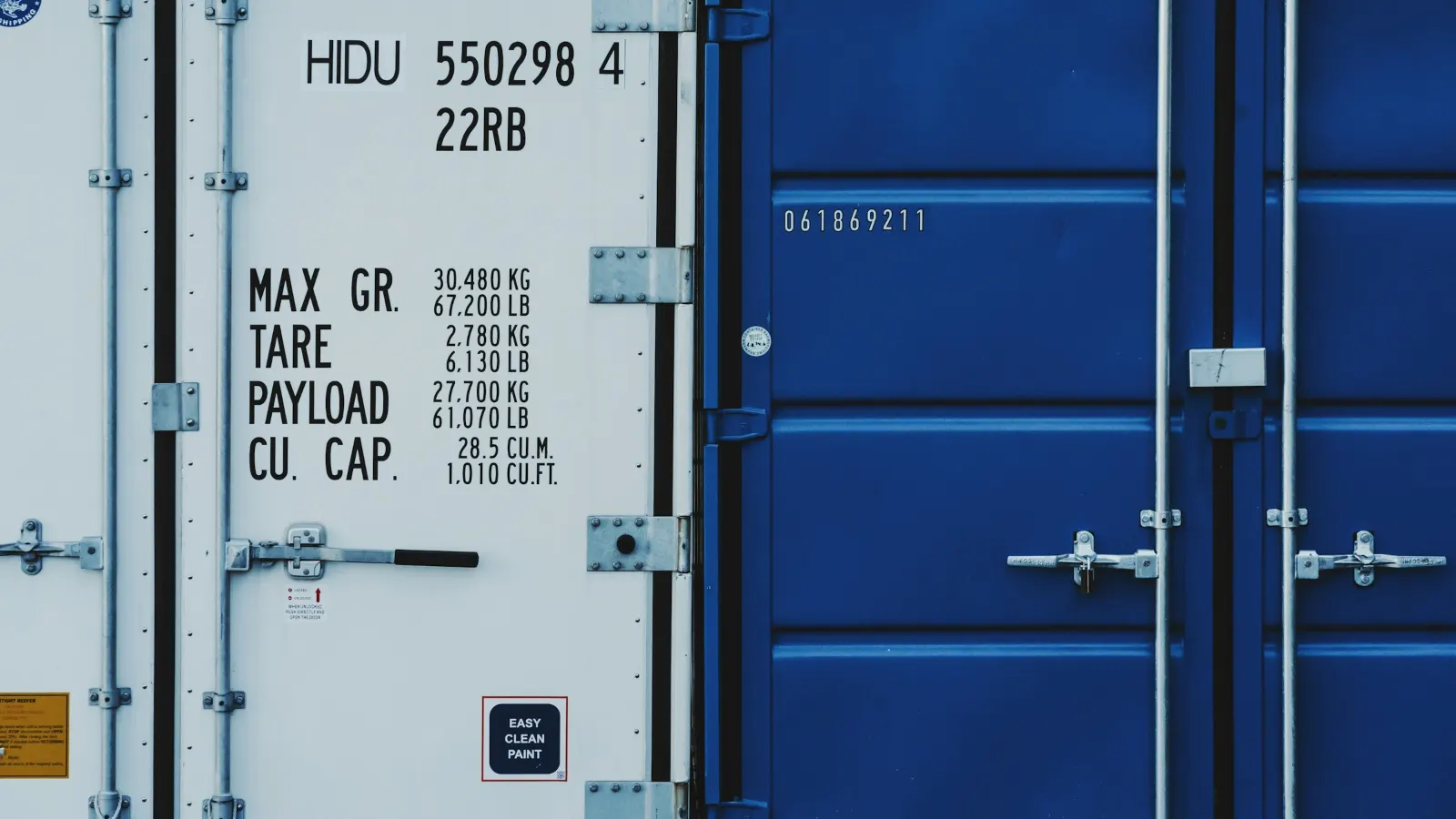



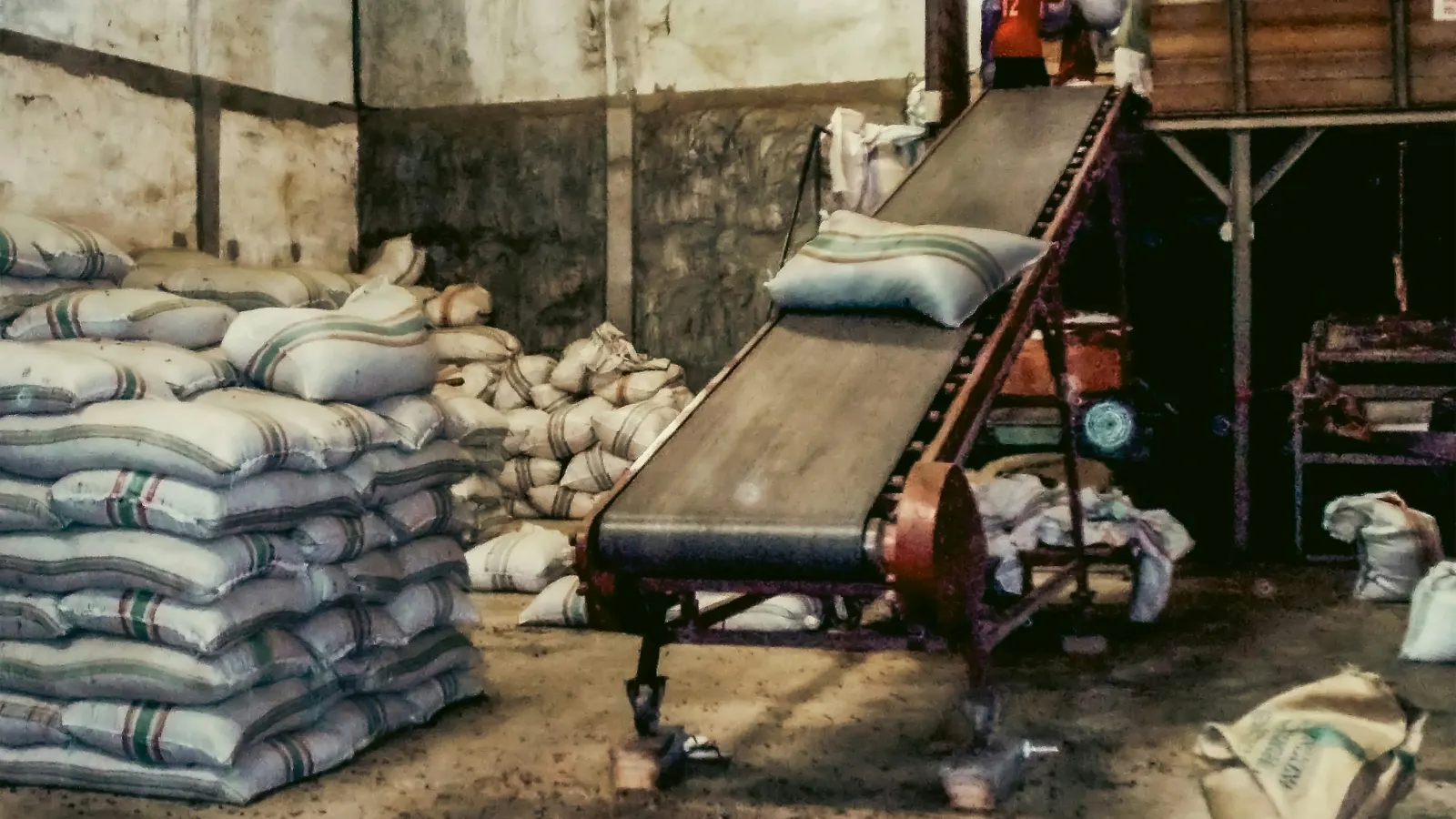
Dunnage is material placed in or around cargo to protect it and hold it in position: timber boards, pallets, kraft paper, cardboard and inflatable dunnage bags (air bags). For bagged and cartoned food it is one part of a larger job. The container must be fit for food, the weight spread along the floor, gaps filled or blocked, moisture managed, and the unit sealed and recorded.
Treat stuffing as a step you specify in the contract and evidence with photographs and records. When damage appears at destination, that evidence often shows whether the problem started at loading or later.
Mode choice, claims handling at unstuffing and insurance terms are covered elsewhere. This guide gives no engineering securing calculations: those depend on the cargo, unit and route, and belong to the packer and, where needed, a surveyor.
Where transit damage to food cargo starts
The main international reference is the IMO/ILO/UNECE Code of Practice for Packing of Cargo Transport Units (CTU Code), endorsed in 2014. It is non-mandatory and applies across the intermodal chain, to those who pack cargo and those who unpack it. IMO still lists the 2014 edition as current on 26 September 2026; UNECE has published a 2025 revision document for consideration at its 12–14 October 2026 session, so check whether that revision has since been formally adopted. IMO, CTU Code; UNECE, CTU Code 2025 revision
TT Club, a transport insurer, reported that its 2020 claims data suggest 25% of wet cargo damage came from water entering the unit through pre-existing damage that probably should have been identified during packing. TT Club, wet damage That is one insurer's data, not a market statistic, but it shows what a pre-loading check can catch.
Stuffing also matters for insurance. The Institute Cargo Clauses (A) exclude loss caused by insufficient or unsuitable packing where that packing is done by the assured or their employees, or before the insurance attaches, and define packing to include stowage in a container. Institute Cargo Clauses (A) 2009 Whether it applies depends on the policy and the facts, but a record showing a sound container and proper stowage is often the cheapest evidence either party can hold.
Pre-loading container inspection
Inspect the empty unit and record the result. The CTU Code says closed units should be clean, dry and free of residue and persistent odours; the floor free of major damage and protrusions such as nails or bolts; the doors able to be locked and sealed; and old labels removed. Leaks can be found by checking whether light enters the closed unit. CTU Code 2014, ch. 8
TT Club adds pests, dust, debris, transferable stains, evidence of repairs, and rust or water trails. TT Club, wet damage For bags, the Container Handbook of GDV, the German insurers' association, warns that splinters, old securing material and nail ends can tear them. GDV Container Handbook, bagged cargo
The Codex food hygiene principles say conveyances should not contaminate food or packaging, should protect against dust and fumes, and should be cleaned, and where necessary disinfected and dried, between loads of different foods or non-food items. Codex, CXC 1-1969, section 15 A unit that smells of its last cargo is a poor choice for flour or sugar. Reject it before loading starts, not after.
Weight distribution and floor loading
The CTU Code's key requirements: do not exceed payload or maximum gross mass, distribute heavy cargo over the floor, do not stow heavy goods on light ones, and keep the centre of gravity correctly located. CTU Code 2014, ch. 3 The industry quick guide adds a check that the container's CSC safety approval plate is valid. CTU Code quick guide
With dense bagged cargo, check early whether weight rather than space is the limit, and spread the load along the floor rather than concentrating it at one end. Road weight limits vary by country; ask the destination haulier what gross mass it can move.
Under SOLAS, the shipper must provide a verified gross mass (VGM) before a packed container is loaded, either by weighing the packed container or by weighing all packages and cargo, including pallets, dunnage and other securing material, and adding the tare. IMO, VGM Dunnage counts in the declared weight, and the packing list and weight note must reconcile with it.
Stowage patterns: bags, cartons and pallets
| Cargo form | Typical risk | Stowage and securing points |
|---|---|---|
| Loose bags (sugar, rice, flour, sesame, gum arabic) | Stacks slip or lean; bags torn; unstable door face | Crisscross or other interlocking stow; boards, plywood or kraft paper between layers as anchors; no sharp edges on the floor |
| Hand-stacked cartons | Crushing in lower tiers; shifting into gaps | Tight stow wall to wall; heavy below light; fill or block gaps; ventilation holes work only in the right orientation |
| Palletised bags or cartons | Pallets shift as blocks | Block or fill gaps between pallets and walls; include pallets in the VGM |
| Mixed loads | Taint or moisture transfer | Keep odour-releasing goods away from odour-absorbing ones, and moisture-releasing goods away from moisture-sensitive ones |
Sources: GDV Container Handbook sections 5.2.11.1, 4.2.5.1 and 10.3.7; CTU Code chapter 3. Whether to palletise or floor-load also changes cost and container fill; that is a buying decision, and this guide deals with making the chosen method secure.
Dunnage, void fill and securing
Gaps let cargo move. The CTU Code asks packers to fill void spaces when necessary and to use blocking, lashing or both to prevent sliding and tipping. CTU Code 2014, ch. 3 The quick guide says the sum of void spaces in any horizontal direction should not exceed 15 cm; beyond that, block the cargo. CTU Code quick guide
Void fill includes timber battens, paperboard, pallets for larger gaps, and dunnage bags. GDV cautions that air bags need smooth surfaces or protected edges and should not be used near the doors. GDV Container Handbook, filling gaps Follow the bag maker's instructions on gap size and inflation.
At the door end, build a secure cargo face so nothing falls out on opening, for example a timber lattice or pallets braced against the rear corner posts; a board between the wall corrugations is not enough. GDV Container Handbook, door area
For lashing, do not fasten web lashings with knots. CTU Code 2014, ch. 3 Wooden dunnage falls within the plant-health standard ISPM 15, whose scope expressly includes dunnage. IPPC, ISPM 15 Unmarked timber can cause a border problem unrelated to the food.
Container condensation, liners and desiccants
Moisture is a particular concern for hygroscopic food such as sugar, flour, grains and spices. The CTU Code sets a mould-growth threshold: relative humidity of 75% or more brings increasing risk of mould on organic substances, including foodstuffs. It also says not to pack wet or damp goods if avoidable. CTU Code 2014, ch. 2–3
Container rain is condensation inside the steel. When the surfaces cool below the dew point of the internal air, vapour condenses on walls and roof; roof sweat drips directly onto the cargo and is the greater risk. GDV Container Handbook, container sweat Moisture sources inside the box include the cargo, packaging, pallets and timber, so the first rule is that all of them go in dry. GDV Container Handbook, moisture
The same section sets limits on the usual remedies:
- Kraft paper or fleece liners protect only until saturated.
- Container desiccants can saturate before the critical moment, often unpacking in a colder port, and belong high in the unit because warm, moist air rises.
- Ventilated containers reduce condensation by letting air circulate.
Desiccants supplement dry cargo and dry timber; they do not replace them. Ask the packer to state the type, number and position used, and photograph them in place.
Seals, seal numbers and documents
On completion, the CTU Code asks the packer to determine the gross mass, affix a seal when required, and include the container number, gross mass and, when required, the seal number in the appropriate documents. CTU Code 2014, ch. 3 The quick guide recommends an ISO 17712 seal for international transport and an accurate seal record from origin to destination. CTU Code quick guide ISO 17712:2013 covers mechanical container seals and was last confirmed in 2023. ISO 17712:2013
The test is consistency: the seal number photographed on the door should match the stuffing report and every shipping document that records it, such as the bill of lading. A mismatch is easy to fix before sailing and hard to explain afterwards. See also the document set behind one shipment.
The stuffing evidence pack to require
Write the evidence pack into the contract or purchase order as a routine document, and name who produces it: seller, packer, or an inspection company appointed by a party.
| Item | What it should show |
|---|---|
| Container condition report | Container number, CSC plate, floor, walls, doors, light test, odour, cleanliness; accepted or rejected |
| Photographs, empty unit | Floor, walls and roof, with the container number in shot |
| Photographs, during loading | Stowage pattern, dunnage, liners, desiccant position |
| Photographs, completed load | Door face and securing, then doors closed |
| Seal record | Seal number, photo of the applied seal, time and place |
| Weights and counts | Units loaded against the packing list; VGM and method |
Photographs help only if they can be tied to the container: ask for a dated sequence that starts and ends with the container number and seal.
Worked example: caked sugar, two evidence positions
Hypothetical teaching example. Consignment, parties and figures are invented, in currency units (CU). No real or Maqboola transaction is represented.
A buyer opens a container of bagged white sugar valued at CU 30,000. Top-tier bags near the doors are caked and stained, and the roof shows water marks. The buyer claims CU 6,000 for downgraded bags, attributed to condensation.
Position A: evidence exists. The pack contains a condition report on a clean, dry unit that passed a light test, photographs of kraft paper lining and desiccants hung high, a matching seal photograph, and ISPM 15 marks on the timber. The parties can move on to transit conditions and the policy terms. Payment is not guaranteed, but the loading question is answered.
Position B: no evidence. No report, no photographs, and a seal number that differs by one digit between the bill of lading and the packer's note. Nobody can show whether the unit was sound or the pallets dry. The CU 6,000 dispute becomes an argument about unknowns, and an insurer may raise the packing exclusion.
Common mistakes
- Accepting a container without an inspection record.
- Loading bags without interlayer anchors.
- Using dunnage bags at the door instead of a braced cargo face.
- Using wet pallets or timber and expecting desiccants to compensate.
- Leaving dunnage out of the VGM or packing list reconciliation.
- Taking photographs that do not show the container number or seal.
Limits and what to recheck
The CTU Code is non-mandatory; national rules, carrier requirements and the contract may be stricter. The 2014 edition remained the current IMO-listed publication on 26 September 2026, while a revised text was due for UNECE consideration in October 2026. Confirm the formally adopted edition before relying on paragraph or chapter references. Road weight limits and plant-health enforcement vary by country. Securing design and desiccant quantity depend on cargo, route and season; for sensitive loads, consult a marine surveyor.
FAQ
What is dunnage in shipping? Material that protects cargo and keeps it in place: timber, pallets, paper, cardboard and dunnage bags. Wooden dunnage falls within ISPM 15.
Do container desiccants stop container rain? Not on their own. They absorb limited moisture and can saturate before unpacking. Dry cargo, dry dunnage and high placement matter more.
Who is responsible for container stuffing? The CTU Code gives duties to the packer, the party that loads and secures the cargo, including checking the unit and determining the gross mass. Your contract should name who packs, who inspects and who supplies the evidence.
Where should dunnage bags not be used? GDV advises against air bags near the doors, and against unprotected sharp edges.
Next step
Before loading starts, send the packer a one-page checklist covering the empty-unit inspection, stowage pattern, dunnage, moisture controls, seal record, weights and required photographs. Do not release the final shipping instructions until the completed evidence pack reconciles with the packing list and VGM.
Resources
- IMO — Code of Practice for Packing of Cargo Transport Units (CTU Code) — https://www.imo.org/en/OurWork/Safety/Pages/CTU-Code.aspx (accessed 26 September 2026)
- UNECE — CTU Code 2025 revision document for the 12–14 October 2026 Working Party session — https://unece.org/transport/documents/2026/07/working-documents/imoilounece-code-practice-packing-cargo-transport (accessed 26 September 2026)
- IMO/ILO/UNECE — CTU Code 2014 (ILO-hosted PDF) — https://www.ilo.org/sites/default/files/wcmsp5/groups/public/@ed_dialogue/@sector/documents/publication/wcms_492710.pdf (accessed 23 September 2026)
- IMO — Verification of the gross mass of a packed container — https://www.imo.org/en/OurWork/Safety/Pages/Verification-of-the-gross-mass.aspx (accessed 26 September 2026)
- Cargo Integrity Group — CTU Code: a quick guide (2022) — https://www.american-club.com/files/files/ctu-code-a-quick-guide-2022-update.pdf (accessed 23 September 2026)
- TT Club — Protecting cargo from wet damage — https://www.ttclub.com/news-and-resources/news/article/tt-talk-protecting-cargo-from-wet-damage/ (accessed 26 September 2026)
- GDV — Container Handbook, section 10.3.7 — https://containerhandbuch.de/chb_e/scha/scha_10_03_07.html (accessed 23 September 2026)
- GDV — Container Handbook, section 4.3.3 — https://www.containerhandbuch.de/chb_e/stra/stra_04_03_03.html (accessed 23 September 2026)
- Codex Alimentarius — General Principles of Food Hygiene (CXC 1-1969, revised 2022) — https://www.fao.org/fao-who-codexalimentarius/sh-proxy/en/?lnk=1&url=https%253A%252F%252Fworkspace.fao.org%252Fsites%252Fcodex%252FStandards%252FCXC%2B1-1969%252FCXC_001e.pdf (accessed 26 September 2026)
- IPPC — ISPM 15 — https://www.ippc.int/en/publications/regulation-wood-packaging-material-international-trade-0/ (accessed 26 September 2026)
- ISO — ISO 17712:2013 — https://www.iso.org/standard/62464.html (accessed 26 September 2026)
- LMA/IUA — Institute Cargo Clauses (A) 1/1/09 (If P&C copy) — https://www.if-insurance.com/globalassets/industrial/files/marine-cargo/institute-clauses/institute-cargo-clauses-a-2009.pdf (accessed 23 September 2026)