



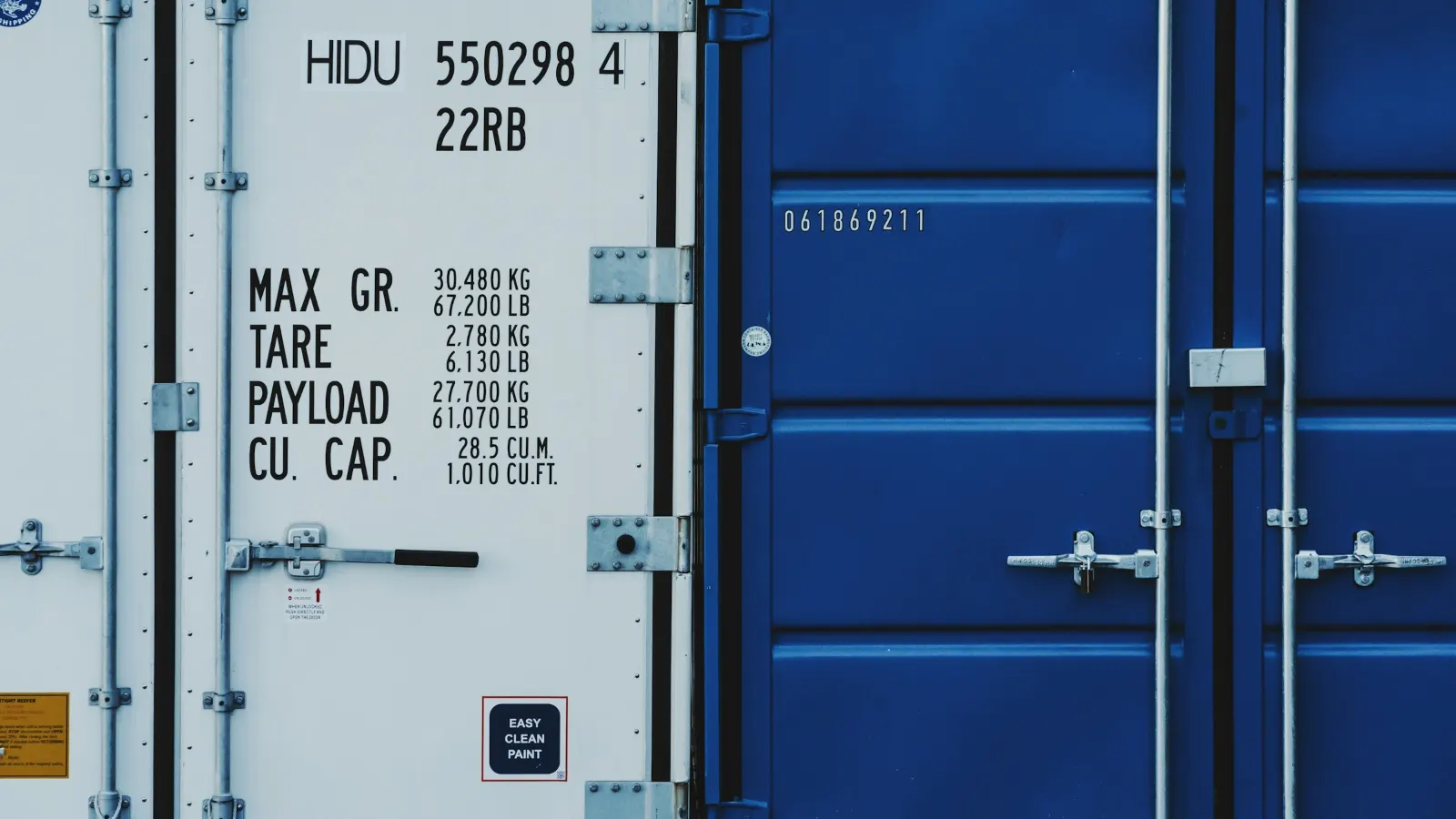
A consignment can be held for a reason unrelated to the goods: two documents describe the same cargo with different numbers.
Short answer on gross weight vs net weight: net weight is the weight of the goods alone; gross weight adds their packaging. HM Revenue & Customs, for example, defines net mass as the weight of the goods without any packaging, and gross mass as goods plus packaging but excluding containers and other transport equipment (HMRC, CDS data elements 6/1 and 6/5). Tare is the packaging weight between the two. The container's own weight enters only the verified gross mass (VGM) required for sea loading. Documents may use different weight bases, but every figure must derive from the same count and weights, visibly.
For who issues each document and when, see the document set behind one shipment.
The figures: net, gross, tare, packages, volume and value
| Figure | What it is | Where it usually appears |
|---|---|---|
| Net weight | Goods only, without packaging | Invoice, packing list or weight note, customs declaration |
| Gross weight | Goods plus packaging; pallet treatment varies | Packing list, bill of lading, customs declaration, often the certificate of origin |
| Tare | Packaging weight, or the empty container's weight in a VGM | Packing list or weight note; container tare on the container and in the VGM |
| Package count and marks | Number and type of packages and the marks on them | Every document that describes the cargo |
| Volume | Cubic measurement, usually rounded | Packing list, bill of lading, freight booking |
| Unit price and total value | Price per unit, extended value, currency | Invoice, customs declaration, letter of credit |
"Tare" has two meanings, packaging and empty container; say which. And declared gross weight need not equal bill-of-lading gross weight: in the UK, HMRC includes pallet weight where the transport documents do, with stated exceptions (HMRC, DE 6/5).
A packing list itemises each package with weights and measurements; forwarders use it for freight and customs officials to check contents (ITA, packing list). A weight note is a commodity-trade term, not an official document class: usually weights by lot, bag or weighbridge ticket, from the seller or a weigher. The contract should say who issues it and on what basis (net or gross, shipped or landed).
What must match exactly, and what may legitimately differ
Customs officials may use the packing list to check the cargo, "so the commercial invoice should reflect the information shown on the packing list" (ITA, common export documents). US import rules require each invoice to state what is in each package; where a weight needed for duty is missing, the consignee pays for weighing before release (eCFR, 19 CFR 141.86(e) and (f)).
| Figure | Must match exactly across | May legitimately differ, and why |
|---|---|---|
| Package count and type | Invoice, packing list, bill of lading, certificate of origin, declaration | Only if one counts pallets and another bags, each labelled |
| Marks and numbers | Packing list, bill of lading, the packages themselves | Not normally |
| Net weight | Invoice, packing list or weight note, declaration | Authority rounding rules; invoicing on landed rather than shipped weight |
| Gross weight | Packing list and bill of lading, when both use the same basis | Pallets included in one only; customs definitions exclude transport equipment |
| Container gross mass (VGM) | Not comparable with the others directly | It adds container tare, dunnage and securing material |
| Unit price, quantity and total | Invoice, declaration, credit terms | Not normally; every total should recompute from quantity × unit price |
Under the Hague-Visby Rules, as scheduled to the UK Carriage of Goods by Sea Act 1971, bill-of-lading packages, quantity or weight are as furnished by the shipper, who is deemed to guarantee their accuracy (legislation.gov.uk, Carriage of Goods by Sea Act 1971, Schedule, Article III). An error in the shipping instructions becomes an error on the bill; see reading a bill of lading.
Weight tolerances in the contract versus discrepancies in the documents
A contract may allow a "more or less" quantity tolerance on bulk rice or sugar. It governs how much may be shipped, not whether documents may disagree. Ship 3% short under a 5% tolerance, and every document shows the same shipped quantity, invoiced as such.
A letter of credit sets its own quantity and amount rules, and banks examine documents against the credit, not the contract. Ask the bank how its tolerance applies before shipment; after a refusal, see why banks refuse documents.
Container gross mass and the verified weight requirement
Since 1 July 2016, SOLAS has required the shipper to state a packed container's verified gross mass, found by weighing the packed container or by weighing all contents, including pallets, dunnage and securing material, and adding the container's tare (IMO, verification of the gross mass of a packed container). IMO guidelines MSC.1/Circ.1475 add three relevant points (IMO MSC.1/Circ.1475, hosted by the UK MCA):
- gross mass in this context includes the container's tare and everything packed inside it (paragraph 2.1.6);
- a packed container should not be loaded unless the master and terminal have its verified gross mass in advance (paragraph 4.2);
- where an earlier declared weight differs from the verified one, the verified gross mass is used (paragraph 9.1).
Enforcement margins are national; the UK Maritime and Coastguard Agency states a ±5% threshold, applied case by case (MCA, MGN 534). That safety margin does not make a packing list 4% wrong acceptable to customs or a bank.
Description consistency and the classification question behind it
Weights are checked against a description, and the description against a tariff code. HMRC requires descriptions specific enough for identification, classification and examination, rejecting terms such as "general cargo" (HMRC, DE 6/8). The WCO's six-digit Harmonized System underpins the tariffs of more than 200 countries and economies (WCO, what is the Harmonized System).
In the EU, a weight-based tariff refers to net weight unless stated otherwise (European Commission, Access2Markets, gross or net weight). Some lines also need a supplementary unit, such as litres, which must agree with the invoice. If the invoice says "rice" and the packing list "parboiled long-grain rice, 25 kg bags", use the fuller description everywhere; the importer's broker confirms the code.
Currency, unit price and total: the arithmetic that gets checked first
This check is the cheapest to run:
- Quantity × unit price = line total, for every line.
- Line totals + stated charges − stated discounts = invoice total.
- The currency code is the same on the invoice, the credit and the declaration.
- The quantity unit (kg, tonne, bag, carton) is the one the unit price uses.
- Net weight per package × number of packages = total net weight.
- Total net weight + total packaging tare = total gross weight on the same basis.
Errors hide most easily in steps 4 to 6: a tonne price applied to kilograms, or pallets added to gross weight on one document only.
A reconciliation routine, and the five-minute version
Full routine, before presentation or filing:
- Derive every document from one master record of count, weights, volume and price.
- Recompute the six checks above.
- Fill in the match table above, document by document.
- Write the reason for every difference: basis, rounding or a genuine change.
- For a genuine change, correct every document issued before it.
- Check the VGM: packing-list gross (with pallets) plus dunnage and container tare should land near it.
- File the reconciliation; it answers a query in minutes.
Five-minute version: package count, net weight, gross weight, invoice total and description, on the invoice, packing list and draft bill of lading.
Worked example: the pallet that left after the packing list
Hypothetical teaching example. All figures are invented; CU is an unnamed currency unit.
Rice in 25 kg bags, 40 bags per pallet, goes into one 20-foot container. Empty bags weigh 0.125 kg, pallets 22 kg; the price is CU 480 per tonne net. The packing list is issued for 20 pallets. One pallet is then held back after damage at the warehouse, so 19 are loaded (double-stacked). The invoice, shipping instructions and VGM are corrected; the packing list is not.
| Figure | Packing list (issued before withdrawal) | Invoice and bill of lading (after withdrawal) |
|---|---|---|
| Pallets / bags | 20 / 800 | 19 / 760 |
| Net weight | 20,000 kg | 19,000 kg |
| Bag tare | 100 kg | 95 kg |
| Pallet tare | 440 kg | 418 kg |
| Gross weight incl. pallets | 20,540 kg | 19,513 kg |
| Value at CU 480/t | CU 9,600 | CU 9,120 |
Calculated VGM: 19,513 kg cargo + 30 kg dunnage and securing + 2,200 kg container tare = 21,743 kg. The weighbridge reads 21,760 kg: 17 kg, under 0.1%, ordinary variation.
The packing list implies 20,540 + 30 + 2,200 = 22,770 kg, 1,010 kg (about 4.6%) above the weighbridge: inside a ±5% margin such as the UK's, so a weight-tolerance test would not flag it. A document check does: 800 bags against 760, and 1,000 kg more net weight than the invoice. One uncorrected document stops the file; reissuing it for 19 pallets and 760 bags resolves it.
Common mistakes
- Using "tare" without saying whether it means packaging or the container.
- Adding pallet weight to gross weight on the packing list but not in the shipping instructions.
- Treating a contract tolerance as permission for documents to disagree.
- Correcting the invoice after a change and forgetting documents issued earlier.
- Writing a short description on one document and a full one on another.
- Assuming a VGM within enforcement margin means the packing list is right.
Limits and what to recheck
This is general information, not customs, legal or banking advice. Weight definitions, rounding, pallet treatment and enforcement margins are set by each authority; the UK, EU and US references are examples, and others differ. Dubai Customs, for example, lists invoice, packing list, certificate of origin and any permit for a declaration (Dubai Customs, Service Guide 2025). Recheck the destination's weight basis with the broker, the VGM method and cut-off with the forwarder, and tolerances with the bank.
Frequently asked questions
What is the difference between gross weight and net weight? Net is the goods alone; gross adds packaging. Whether pallets count depends on the document and authority, so state the basis.
Is tare weight the packaging or the container? On a packing list, usually packaging; in a VGM, the empty container. Label it.
Does the VGM have to equal the packing list's gross weight? No. The VGM adds container tare, dunnage and securing material, but should land close to packing-list gross plus those items.
Which weight do customs use for duty? It depends on the tariff line and authority; in the EU, net weight unless stated otherwise. Ask the importer's broker.
Next step
Before finalising the shipping instructions, place the invoice, packing list and draft bill of lading side by side. Recalculate package count, net weight, gross weight and invoice value from one master record; record the reason for every difference, then ask the importer's customs broker to confirm the declaration basis.
Resources
- HM Revenue & Customs — CDS import completion guide, Group 6 — https://www.gov.uk/government/publications/cds-uk-trade-tariff-volume-3-import-declaration-completion-guide/group-6-goods-identification (accessed 25 September 2026)
- US International Trade Administration — Common Export Documents — https://www.trade.gov/common-export-documents (accessed 23 September 2026)
- US International Trade Administration — Packing List — https://www.trade.gov/packing-list (accessed 23 September 2026)
- US eCFR — 19 CFR 141.86 — https://www.ecfr.gov/current/title-19/chapter-I/part-141/subpart-F/section-141.86 (accessed 25 September 2026)
- UK legislation — Carriage of Goods by Sea Act 1971, Schedule — https://www.legislation.gov.uk/ukpga/1971/19/schedule (accessed 23 September 2026)
- International Maritime Organization — Verification of the gross mass — https://www.imo.org/en/OurWork/Safety/Pages/Verification-of-the-gross-mass.aspx (accessed 25 September 2026)
- International Maritime Organization — MSC.1/Circ.1475 (UK MCA copy) — https://assets.publishing.service.gov.uk/media/5a7f1cdeed915d74e33f4693/MSC.1-Circ.1475.pdf (accessed 23 September 2026)
- UK Maritime and Coastguard Agency — MGN 534 (M+F) — https://www.gov.uk/government/publications/mgn-534-mf-guidance-on-the-implementation-of-the-solas-vi-regulation-2-amendment-requiring-the-verification-of-the-gross-mass-of-packed-containers (accessed 25 September 2026)
- World Customs Organization — What is the Harmonized System — https://www.wcoomd.org/en/topics/nomenclature/overview/what-is-the-harmonized-system.aspx (accessed 23 September 2026)
- European Commission, Access2Markets — Gross or net weight FAQ — https://trade.ec.europa.eu/access-to-markets/en/faqs/when-tariff-refers-weight-it-gross-weight-or-net-weight (accessed 25 September 2026)
- Dubai Customs — Service Guide 2025 — https://www.dubaicustoms.gov.ae/en/OpenData/Publications/DubaiCustomsServiceGuide2025_V09.pdf (accessed 25 September 2026)